DIVINE JUSTICE: Work for your salvation
Matthew 20:1–16
1For the kingdom of heaven is like a landowner who went out early in the morning to hire labourers for his vineyard. 2Now when he had agreed with the labourers for a denarius a day, he sent them into his vineyard. 3And he went out about the third hour and saw others standing idle in the marketplace, 4and said to them, you also go into the vineyard, and whatever is right I will give you. So they went. 5Again he went out about the sixth and the ninth hour, and did likewise. 6And about the eleventh hour he went out and found others standing idle, and said to them, why have you been standing here idle all day? 7They said to him, because no one hired us. He said to them, you also go into the vineyard, and whatever is right you will receive.
8So when evening had come, the owner of the vineyard said to his steward, call the labourers and give them their wages, beginning with the last to the first. 9And when those came who were hired about the eleventh hour, they each received a denarius. 10But when the first came, they supposed that they would receive more, and they likewise received each a denarius. 11And when they had received it, they complained against the landowner, 12saying, ‘These last men have worked only one hour, and you made them equal to us who have borne the burden and the heat of the day.’ 13But he answered one of them and said, friend, I am doing you no wrong. Did you not agree with me for a denarius? 14Take what is yours and go your way. I wish to give to this last man the same as to you. 15Is it not lawful for me to do what I wish with my own things? Or is your eye evil because I am good? 16So the last will be first, and the first last. For many are called, but few chosen.
Good Eye and Evil Eye
The aim here is not to go into the specifics of the concepts of “good” and “evil.” In Matthew 20:15 Jesus asked the first group of labourers who murmured because the last group received the same pay with them: “Is it not lawful for me to do what I wish with my own things? Or is your eye evil because I am good?” Besides the clarification that the Master was free to do what he wished with his riches, observe the link between the “eye”, “evil”, and “the good” in the interrogation: “…is your eye evil because I am good?”
In scriptural and Hebraic usages, the terms “good eye” (Greek: ophthalmos haplos) and “evil/bad eye” (Greek: ophthalmos poneros) are figurative expressions for a person’s inner moral disposition toward others. Any further clarification?
An “evil eye”, which alludes to greed and envy, signifies stinginess, selfishness, and resentment (cf. Prov 23:6; Matt 6:22–23; Matt 20:15). It depicts a person who begrudges the success or fortune of others, hoards wealth, or refuses to assist the needy. On the other hand, a “good eye”, which refers to generousity and kindness, denotes a generous and open-handed attitude. In Proverbs 22:9, we read that a person who has a generous eye will be blessed because such a person gives his or her bread to the poor. This is altruism.
Hence, when Jesus asked the workers who complained, “…is your eye evil because I am good?” He was actually asking them, “Why are you against his generousity towards their fellow workers?” Jesus did not wrong them because he paid them the amount they agreed on.
Cooperation with Divine Grace
“The God who created you without you will not save/justify you without you” (Qui fecit te sine te, non te salvat sine te/non te iustificat sine te). This popular saying is usually attributed to Augustine of Hippo ((Sermon 169:11,13). What is the meaning? Usually we expect results from people. But what God expects from us is not a result but rather effort and good effort alone.
In the parable above, the master intentionally went out in the morning to search for laboureres to work in his vineyard. He found some and employed them after agreeing with them on the amount to pay them. The master went out at other times, including when it remained only one hour before the close of the day’s work. What Jesus considered for paying them the same amount he paid those who had been working since morning was their effort. About the eleventh hour (5 pm), the master went out, found some labourers standing idle, and said to them, “Why have you been standing here idle all day?” The labourers told him they were standing idle “because no one hired us.” Then Jesus asked them to go and work in his vineyard and promised to give them “whatever is right.”
The master said to the group he found standing idle by 5 pm, “Go into the vineyard, and whatever is right you will receive.” When it was time for payment, the master paid this last group the same amount he paid those who have been working since morning. Those people were willing to work. Unfortunately, no one employed them. The master gave them whatever is right because of their effort. They did not sit at home praying alone. They prayed and stood where they could be employed. That is the meaning of the saying that, “The God who created you without you will not save you without you.” It means you must cooperate with God’s grace. The workers employed in the morning showed their cooperation with divine grace by standing where they would be employed. Those employed by five o’clock in the evening also cooperated and strongly believed in God to the extent they remained and hoped even when it was late. Salvation is neither automatic nor free. You must earn your salvation through your good work.
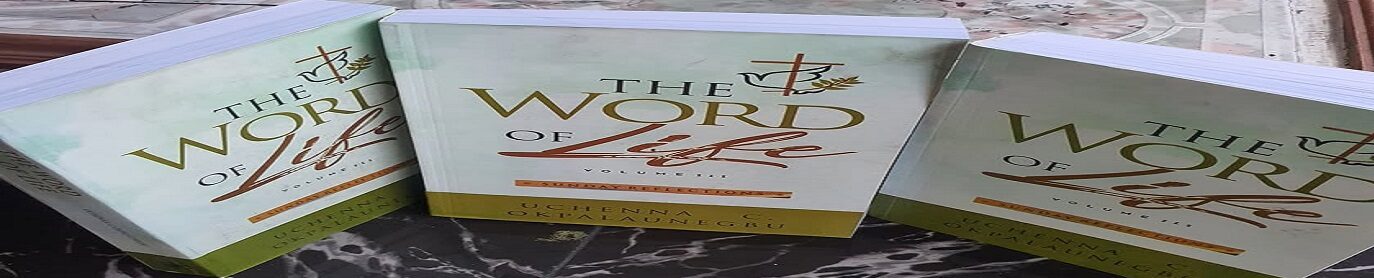
FOR DETAILS, GET YOUR OWN COPIES OF THE BOOK “THE WORD OF LIFE:
SUNDAY REFLECTIONS” (vols. I‑II-III)!! The reflection for the 25th Sunday of the year (A) is found in The Word of Life, vol. I, pages 454–463. Happy reading!
For details on how to get it, contact the author at this link: https://m.me/uchennabiblia?fbclid=IwAR2yeg4a6sDGBp9QGkIvKj6FSADumMokN6lshdE0zuo-JHs6qOmlhA7jyHo
Or email me at postmaster@uchennabiblia.com
or send an SMS to 08116100926, and I will get back to you. Thanks.